

Legacy system migration without downtime: three ways to move, a step-by-step plan, and when each approach fits your business.

Legacy system migration is risky because the old system often runs the core of the business. Orders and customer records pass through it every day. If it goes down during the move, work stops. In the ITIC 2024 downtime survey, over 90% of mid-size and large firms put one hour of downtime above $300,000. Those are the firms’ own estimates, but they show why the move needs a plan. This guide covers three ways to migrate and a step-by-step plan that keeps the business running.
Why Legacy System Migration Is Risky for a Running Business
Old systems do more than their documents say. Over the years, people add small fixes and connect other tools to them. A report that one team uses every Monday may depend on a rule nobody wrote down. When a team moves the system, these hidden jobs are easy to miss.
Staying put costs money too. In an Ensono survey of 500 IT decision-makers, 49% said their legacy maintenance costs went over plan in the last year. So the goal is to move in steps, with the old system running until the new one is proven.
Three Ways to Migrate a Legacy System
There are three common ways to move to a new system. Each one trades speed against risk.
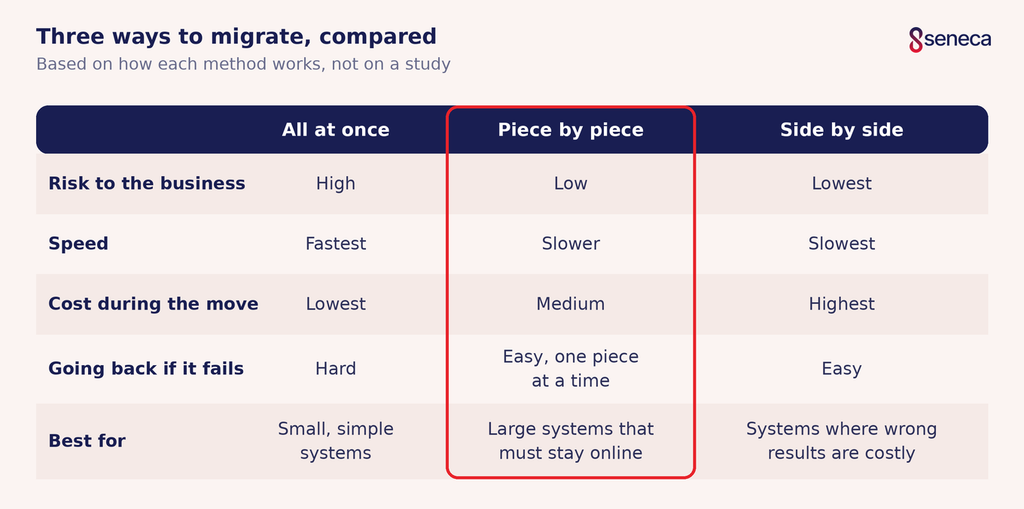
All at once (big bang). The team builds the new system, then switches everyone over on one day. It is the fastest path on paper. However, any problem hits the whole business at the same time, and going back is hard.
Piece by piece. The team moves one function at a time and leaves the rest on the old system. Microsoft calls this the strangler fig pattern. A routing layer sits in front of both systems. It sends each request to the old system or the new one, and the team shifts more work to the new side over time. In the end, the old system is switched off.
Side by side (parallel run). Both systems run at the same time on the same work. The team compares the results and switches only when they match. It is the safest option. On the other hand, you pay to run two systems, and your staff may have to do some work twice.
The table below compares the three ways.
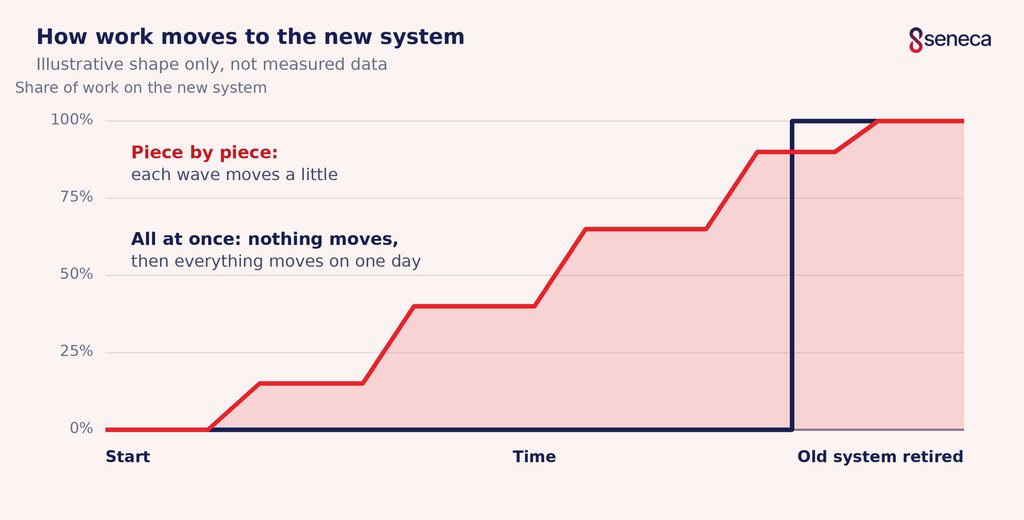
The chart below shows the main difference. With one big switch, nothing moves for a long time and then everything moves in a single day. Piece by piece, each wave moves a little, so a mistake stays small.
A Step-by-Step Legacy System Migration Plan
A good legacy system migration plan has six steps. Each one keeps the old system running until the new piece is proven.
- List what the old system does. Write down every job it handles, including reports, imports and small fixes. Ask each team what they use it for. This is how you find the hidden jobs.
- Pick the first piece. Choose something small and low-risk, such as reports. A safe first win shows the plan works.
- Build the new piece and test it. Test it with real data, not just sample data. Most surprises show up here.
- Run both systems for a short time. Send the same work to the old and the new piece. Compare the results. Move on only when they match.
- Keep a way back. Before each switch, decide how to return to the old piece. If something breaks, the team can undo the change in minutes, not days.
- Repeat, then retire the old system. Move the next piece in the same way. When the last piece works, switch the old system off.
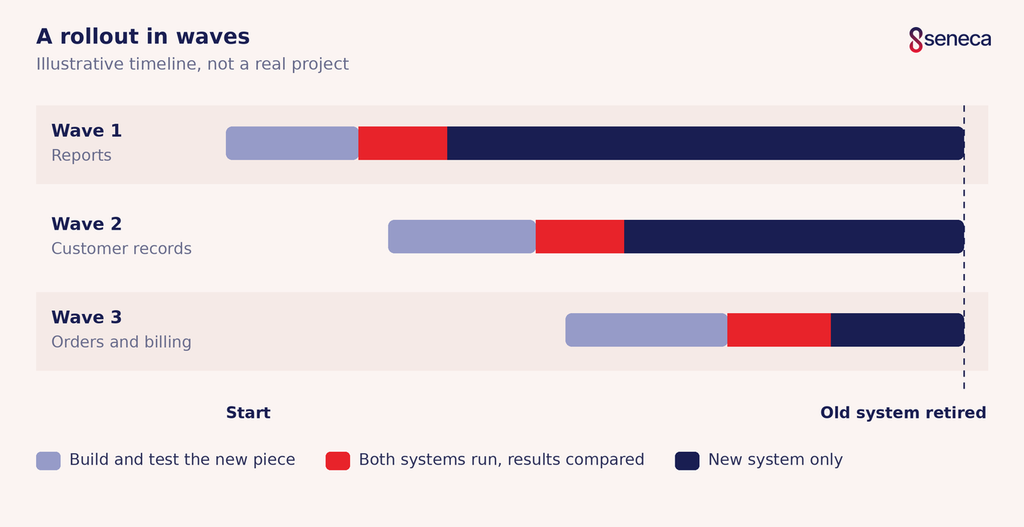
The chart shows how the waves overlap. The next wave starts before the last one ends, so the team never waits with nothing to do.
When Piece by Piece Is Not the Right Fit
Moving piece by piece works for most large systems, but not for all of them. Microsoft lists cases where the strangler fig pattern may not suit your project:
- You can’t intercept requests. The routing layer needs to see each request. If it can’t, it can’t split the work between the two systems.
- You have no access to the old code or another way in. The team needs some point where the new system can connect to the old one.
- The system is small and simple. Replacing it in one go may take less time than building a routing layer.
- You must switch off the old system fast. Piece by piece keeps both systems alive for a while, so it is slow by design.
If one of these fits you, a big-bang move or a short parallel run may be the better choice for your legacy system migration.
FAQ
How long does a legacy system migration take?
It depends on the size of the system and how many hidden jobs it has. A small system can take a few months. A large one that runs the core of the business can take much longer. Moving in waves lets you plan one wave at a time instead of guessing one big date.
Can I migrate with no downtime at all?
Often you can get close. Piece by piece and side by side keep the old system running while the new one is tested. Still, each switch has a short moment of risk. Plan it for a quiet hour and keep the way back ready.
Is it cheaper to keep the old system?
Not always. In the Ensono survey, 49% of IT decision-makers said legacy maintenance costs went over plan in the last year. Compare that cost with the cost of a phased move before you decide.
Enjoyed this article?
Let’s talk about how a focused outsourcing partner can move your roadmap forward.